


Ever watched someone navigate a conversation effortlessly and wondered what their secret might be? While some people appear naturally gifted at communication, Charles Duhigg’s Supercommunicators reveals that masterful conversation is a skill built on identifiable patterns and practices. Through extensive research and compelling case studies, Duhigg uncovers the hidden techniques that exceptional communicators use, often unconsciously, to forge meaningful connections. He shows that anyone can learn and apply these skills to foster deeper connections.
As someone who is neurodiverse, I’ve often struggled with understanding subtle conversational cues and predicting the direction of a discussion. After reading the book, I found Duhigg’s framework as one of the practical frameworks to look at how we make conversations with others. Here are the key insights from the book:
The Core Insight: Paying Attention to Conversations
One of the key takeaways from Duhigg’s work is the importance of paying close attention to the conversation itself. Too often, we focus on speaking in the moment without considering the flow and dynamics of the discussion. However, putting in a little extra effort to analyze the conversation’s direction can enhance our ability to connect with others and improve relationships.
The Matching Principle: The Key to Successful Communication
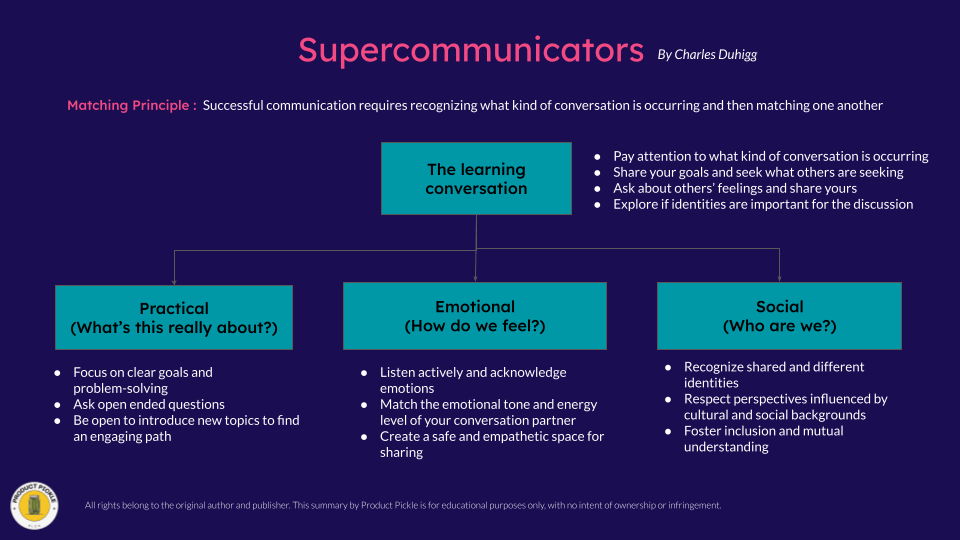
The central idea in the book is what Duhigg calls the “Matching Principle”—the notion that successful communication relies on recognizing the type of conversation taking place and aligning our approach accordingly. When we are “neurally aligned” with the other person, meaningful connections naturally follow.

Step-1: Identifying the Type of Conversation
The first step towards effective communication, according to Duhigg, is recognizing what kind of conversation is taking place. He refers to this as the “Learning Conversation,” which involves taking time to understand the conversation’s nature and adapting our communication style to suit it. This can be achieved by:
- Paying attention to the type of conversation occurring.
- Sharing your goals and understanding what others are seeking.
- Asking about others’ feelings and sharing your own.
- Exploring whether social identities play a role in the discussion.
The Three Types of Conversations
Duhigg categorizes conversations into three distinct types:
- Practical (Decision-Making Conversations): “What is this really about?” These conversations focus on solving problems, making decisions, and exchanging information.
- Emotional Conversations: “How do we feel?” These focus on sharing and understanding emotions, building trust, and fostering empathy.
- Social Identity Conversations: “Who are we?” These revolve around our roles, values, and sense of belonging in relation to others.
While most conversations may contain elements of all three types, the key is to identify the dominant type and adjust our approach to match it.
Practical Conversations: Making Decisions Together
Success in practical conversations requires clear communication of objectives and collaborative exploration of solutions. Key strategies include:
- Explicitly sharing your goals while seeking to understand others’ desired outcomes.
- Using open-ended questions to explore different perspectives.
- Remaining flexible and willing to pivot when the current approach isn’t working.
- Finding common ground through active listening and collaborative problem-solving.
Emotional Conversations: Building Connections through Feelings
Unlike practical conversations, the goal isn’t to solve a problem but to create understanding and connection. To navigate emotional conversations effectively:
- Pay attention to emotional cues and respond with appropriate questions or personal sharing.
- Match the emotional tone and energy level of your conversation partner.
- Create a safe space for vulnerable sharing.
- Focus on understanding rather than problem-solving.
Social Conversations: Understanding Who We Are
These conversations help us understand how we fit into various social groups and communities. Key aspects of successful social identity conversations include:
- Recognizing and acknowledging shared identities.
- Respecting differences while finding common ground.
- Being open to exploring new shared identities.
- Understanding how different social identities influence perspectives and experiences.
Through real-life scenarios, the book offers practical insights into improving conversations and making them more fulfilling. Below is a high-level summary of the framework:
Final Thoughts
At its core, Duhigg’s findings highlight that humans have different needs during conversations—whether practical, emotional, or social. These conversation styles mirror our fundamental desires and how we seek to relate to others. Recognizing them can empower us to foster deeper, more meaningful interactions.
By learning to identify and adapt to different types of conversations, we can improve our communication skills and build stronger, more meaningful relationships.
Have you tried applying these techniques in your conversations? I’d love to hear your thoughts!

Leave a comment