


When I started using ChatGPT, I had the same unsettling feeling that most of us had -talking to an AI that could potentially pass the Turing test. However, I soon got used to it and ChatGPT became my go-to interface to ask my questions and testing its limits on how good or bad the responses are.
I realized that ChatGPT is a great way to expose the Large Language Models (LLMs) to wider audience and its straight forward interface makes it easy for anyone to get started. However, my Product Manager brain kicked in and saw a few pain points in the interface that could be challenging for the users. Below are two of them, based on my experience:
- I have to repeat the instructions or set the context every time for similar tasks
- Once I found a good instruction set or a prompt, there’s no easy way for me to share it with others
This is where I thought GPTs makes perfect sense as a feature to solve both the pain points.
Job Application Example
One simple use-case that many of us can relate to is using ChatGPT to apply for a job application. Before GPTs, we had to provide details of our CV, work experience, etc., every time we needed help with a tailored cover letter or application questions. With GPTs, we can create a custom GPT with instructions about our CV and work experience. For each new application, we just need to provide the job description to get tailored help.
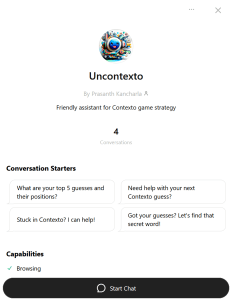
Uncontexto GPT
One of my favorite examples where I use GPT to help with the game ‘Contexto’. Contexto is a guessing game with simple rules:
- Players must guess the secret word, which is ranked number 1 by an AI algorithm based on its similarity to other words.
- Players can make unlimited guesses, and after each guess, they will be shown the position of the word they submitted in the AI’s ranking.
- The goal is to find the word that has been ranked number 1 by the AI, which has determined the ranking by analyzing thousands of texts and calculating how similarly the words are used in context
Before GPTs, I had to initially give the context to ChatGPT to get help with the guesses. You can see how the conversation went here .
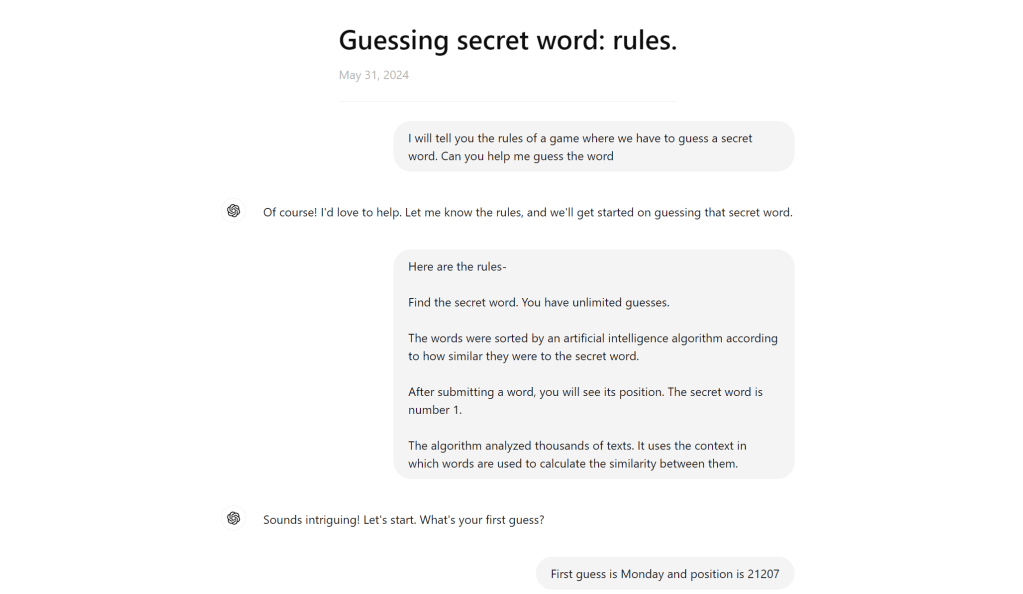
The next time I played the game, I had to repeat the instructions or use the same context window.
But with a GPT created specifically to help me with the puzzle, I can directly start the conversation by giving it the position of the words and get the hint. Because the GPT is already aware of the context. I created a GPT named ‘Uncontexto’ that can help with hints to solve the puzzle. Here is an example conversation with Uncontexto GPT.
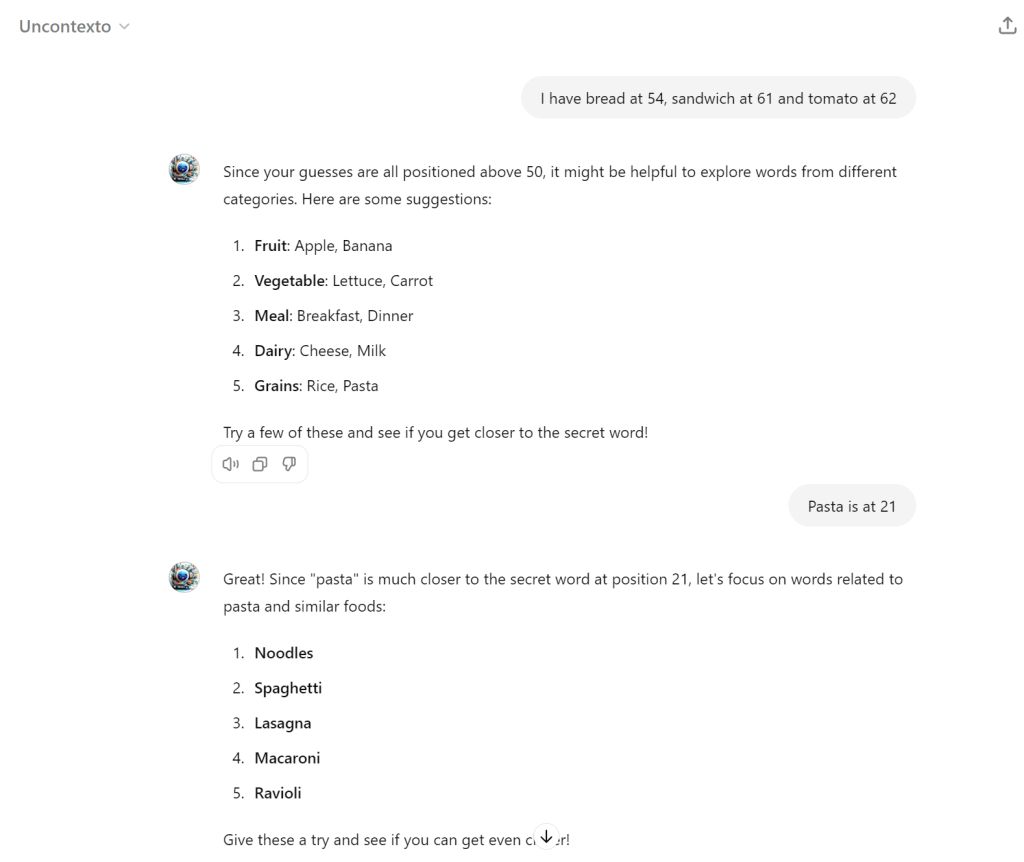
This also allows me to share the GPT with others who are looking for hints to play the game, so they don’t have to write the instructions again.
Market Place Strategy
The GPT marketplace also makes sense as it solves the second problem and makes it easy for anyone to share their GPTs with others. If we create a GPT, it can be easily published to the marketplace to make it discoverable by others.
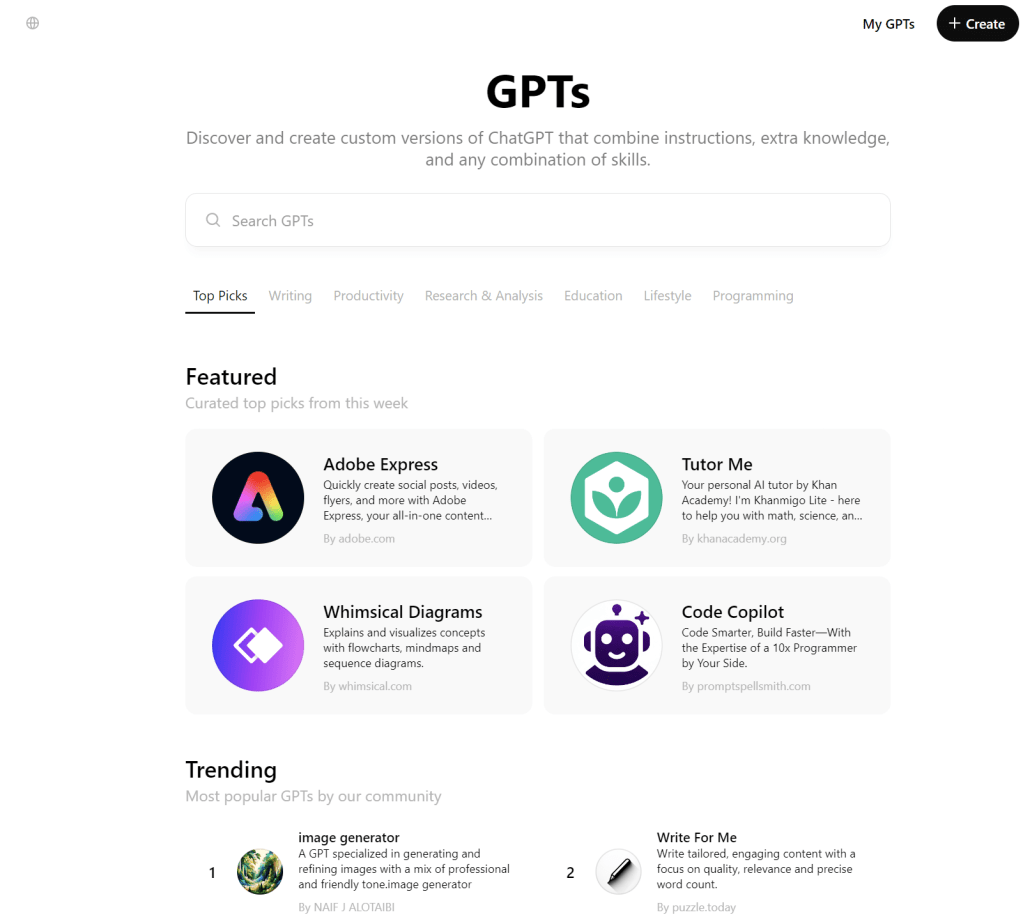
While creating the GPTs, apart from the instructions, we can also provide additional data (Knowledge) and add an action to retrieve information from an API. This is the real differentiator that helps users in creating better GPTs that are not just based on ‘instructions’. As it is easy for anyone to create a GPT, the ‘Knowledge’ of the GPT will set them apart.
Future Enhancements
One of the shortcomings of GPTs is that they are currently only accessible from the ChatGPT interface. As a next step I would like to see the ability for GPTs to be exposed as APIs. This would bring a lot of value to GPT creators as other LLM applications could directly call the GPTs and leverage their functionality.
Overall, I think GPTs are an interesting feature of ChatGPT and makes ChatGPT easier to use.
My GPTs
Feel free to check out two of the GPTs I created.
Make Connections is a GPT to get help with New York Times Connections Puzzle
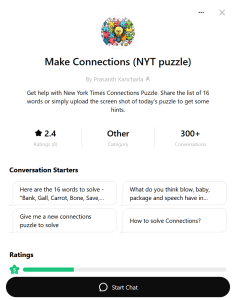
Uncontexto is a GPT to get help with the daily puzzle Contexto

Leave a comment